
Narita International Airport · NRT
Stopover in Tokyo: what to do and when to leave
Narita is much further from Tokyo than Haneda. Going to the capital involves immigration, train, controls and a long return; Narita-san and Omotesando are a more controllable local outing when the layover leaves real room.
With less than 9 hours, it is usually better to stay in NRT. From 10–12 hours Narita-san can fit; central Tokyo requires a very large stopover and a closed railway loop before starting.
Your safety comes first. Reviewed on August 15, 2026 · Guidance, not immigration authorization.
At a glance
The essentials before you decide
Indicative timings: always confirm schedules and closures for the day of your layover.
- Minimum time to leave
- 10 h or more
- Time to city centre
- 55–90 min
- Terminals
- T1 · T2 · T3
- Return buffer
- Return 3 hours before international departure.
- Main transport
- Narita Express, Skyliner and local train
- Does transport run overnight?
- Limited — check the last and first service
- Can you sleep inside?
- Check the overnight policy before relying on it
Quick decision
Leave for Tokyo?
Only from 10 h of stopoverAnd only if you have confirmed entry, luggage to your destination and a protected return.
Check the entry requirements for Japan before crossing immigration.
Confirm that the luggage is checked to the final destination before departure.
Guidance margin, not an official requirement.
Depending on the duration
What to do during your stopover

Stay airside
Food, lounge or rest near the gate are much safer than trying to cross immigration.

Narita calmly
Take advantage of the terminal services and avoid committing a long trip to the center.

Narita-san essential
The temple and Omotesando are a local exit, compact and easy to reverse.

Tokyo only with margin
Tokyo Station or Ueno can fit if the return train, terminal and border are resolved.
Safe decision
What changes
the calculation
Calculate the time you can actually use. Not every hour of a layover is usable.
Entry requirements
Visa, eTA or exemption depending on your nationality.
Minimum connection time
Consider the MCT of the airport and your itinerary.
Procedures and controls
Immigration, security and possible additional procedures.
Transfers
Transfers between terminals and to the city center.
Day and time
Traffic, schedules and city activity.
Unexpected changes
Delays, gate changes or operating conditions.
Door-to-door timingWhere your layover time goesSee breakdown
These are indicative ranges. Queues, time of day and terminal changes can lengthen every stage.
- 01Arrival at the gate 0:00
Confirm the terminal and departure gate.
- 02Border and departure 0:35–1:10
Varies by flight, passport and slot.
- 03Towards Narita-san0:20–0:35
Train or local bus plus access to the station.
- 04Protected return 3:00 before
Reserve room for train, security and gate.
Practical airport guide
Terminals, night and transport
The details that most often decide whether a layover stays comfortable. Confirm live operating information before travelling.
Terminal connection
T1 · T2 · T3
- Usual transfer
- Walk or connected buildings
- What to expect
- T1 is next to Narita Airport Station; T2 and T3 share a station, but T3 requires more walking.
- Controls
- The change may require immigration or clearing security again
Overnight layover
What remains usable at night
- Terminal
- No closure is listed in this guide; confirm official hours
- Public transport
- Limited — check the last and first service
- Sleep inside
- Check the overnight policy before relying on it
- Rest and showers
- Lounges and breaks according to terminal
Airport hotel
Nine Hours Narita Airport
At or near the airport, in the public area
- Zone
- Landside
- Terminal
- Confirm the exact terminal · airport layout: T1 · T2 · T3
- Immigration
- Yes — it is in the public area
- Cancellation
- Depends on the selected rate · check before paying
The search opens with the hotel and city preselected. Confirm the exact property, access conditions and rate before paying.
Actionable transport
Narita Express or Skyliner
- Realistic journey
- 70 min each way
- Indicative price
- Check rate
- Where to board
- T1, T2, T3
- Frequency
- Check the live timetable and service alerts
- Ticket
- Use the operator’s official channel or the machines indicated at the station
Useful services
Find them before walking across the terminal
A service is marked as mentioned only when it already appears in this airport’s reviewed guide data. Always confirm its location and opening hours.
Airport orientation
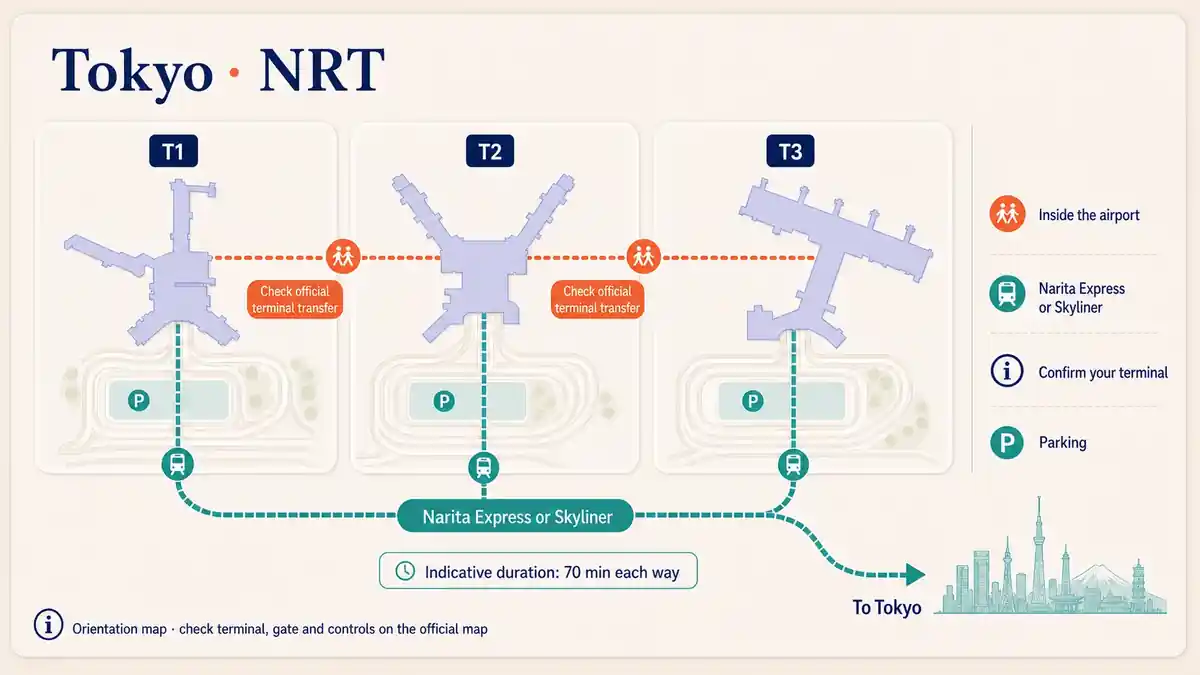
Narita International Airport campus map
An orientation infographic for terminals, internal transfers and transport to the city; always confirm the route on the official map.
Routes with margin
Choose a plan you can cancel
Narita-san + Omotesando
10–12 hour layoverThe most reversible local exit; avoid using a layover just for central Tokyo.
Open routeTokyo Station
13 hours or moreOnly with a very large stopover and the railway return decided before starting.
Open routeInside the airport
Plan B without leaving
When not all conditions are met, the best plan is to conserve energy and connection.
Your terminal station
T1 is next to Narita Airport Station; T2 and T3 share a station, but T3 requires more walking.
Return route
Narita Express and Skyliner arrive at different areas: train stop, terminal and last service before leaving.
Break
Lounges and rest options are preferable if the calculation does not leave a truly protected urban exit.
Quick answers in NRT
Find what you need
Don’t guess where it is. Choose what you are looking for and we will tell you which area to check, with the official directory just one click away.
Try a quick search:

T1 · T2 · T3 · confirm your terminal
A break without missing the gate
Narita allows you to search for restaurants and cafes by T1, T2 and T3. Official maps distinguish public zones and areas after passport control.
See location and official routeThe shops, hours and accesses change. This guide points out where to check it; The official airport directory has the final say.
Your layover, without improvising
Make it yours in 30 seconds
Choose how much margin you have, mark the three critical checks, and save the guide to return to during your trip.
Recommended plan
Narita-san + Omotesando
Tokyo. Leave only if entry, baggage and transportation ( Return 3 hours before international departure. ) are resolved before you start.
Your connection is not generic
Plan your stopover in Tokyo
Our tool estimates your actual time, shows you what you can do, and helps you decide with confidence.
Frequently asked questions
Before deciding
Can I leave Narita during a layover?
Yes, if you meet the entry requirements for Japan, your baggage is checked through to the final destination and you have enough time to return to your terminal, pass security and reach the gate.
How long does it take from Narita to Tokyo?
The fast train takes approximately one hour to reach its main stations; adds immigration, access to the platform, possible connections and the final journey.
What to do with a 10-hour layover in Narita?
Narita-san Shinsho-ji and Omotesando are the most prudent choice. Central Tokyo only compensates with a much longer layover and a conservative rail return.